
There was a lot of ground covered in the recent 2025 National Walking & Cycling Participation Survey from Cycling and Walking Australia New Zealand (CWANZ). Let’s break it down a little.
First up, how many people ride a bike in WA?
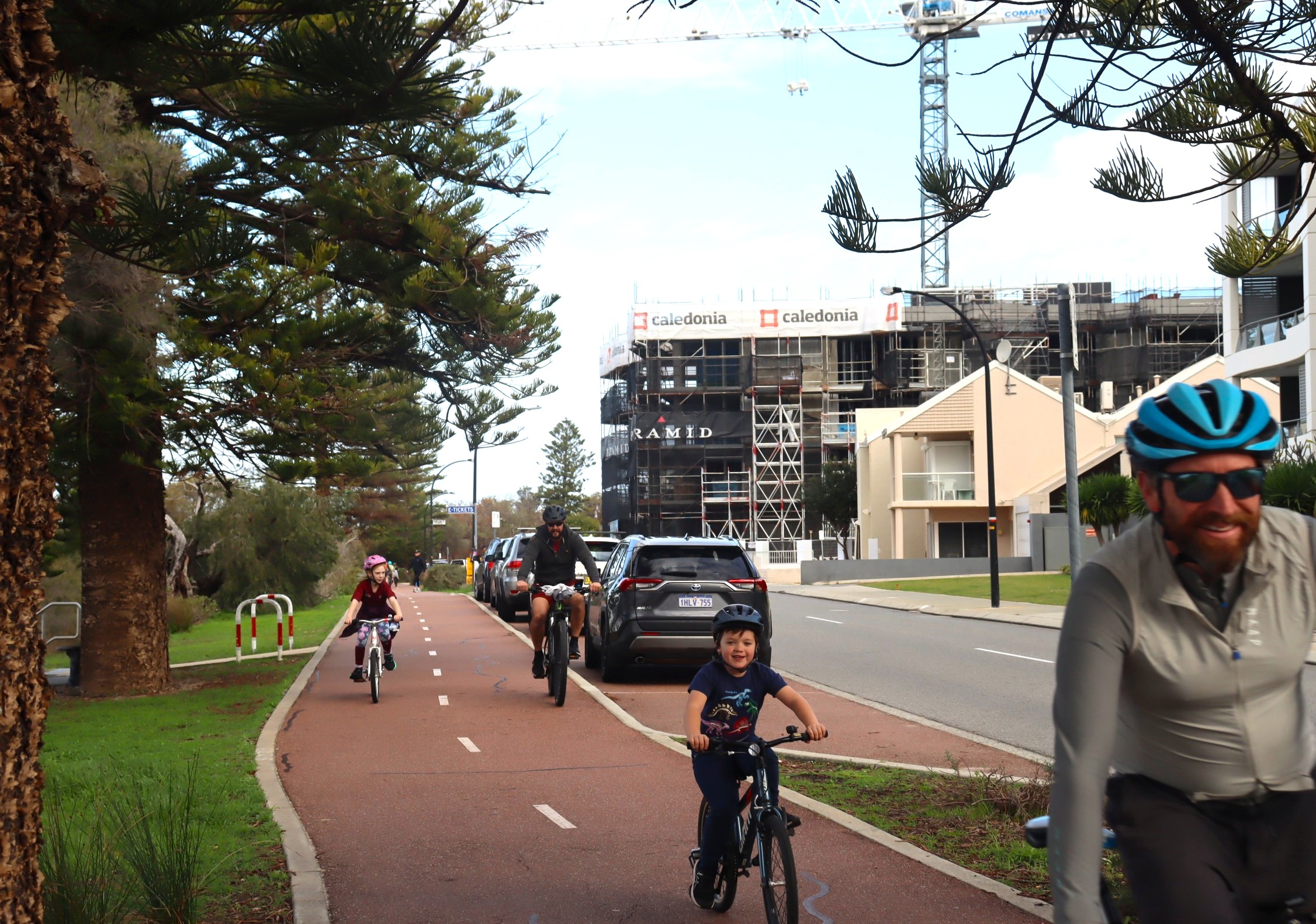
This year’s survey found weekly cycling rates sit at 16.5% (504,485 people), monthly at 25.9% (791,889 people), and annual at 37.6% (around 1,131,271 WA residents).
Is this good? Well, obviously we’d like it to be a lot higher! But it is pretty amazing that half a million people in WA ride a bike every week!
The report is trying hard to put a positive spin on the WA results with the recent uptick, but the long-term numbers don’t lie. While the annual participation rate is slightly higher than two years ago, when you zoom out to chart the results since the survey started in 2011, participation is trending downwards in WA, while the national results remain fairly steady over that time.
As you can see below, this is also true for weekly and monthly participation rates.
More work to do!

Shifts in why we ride
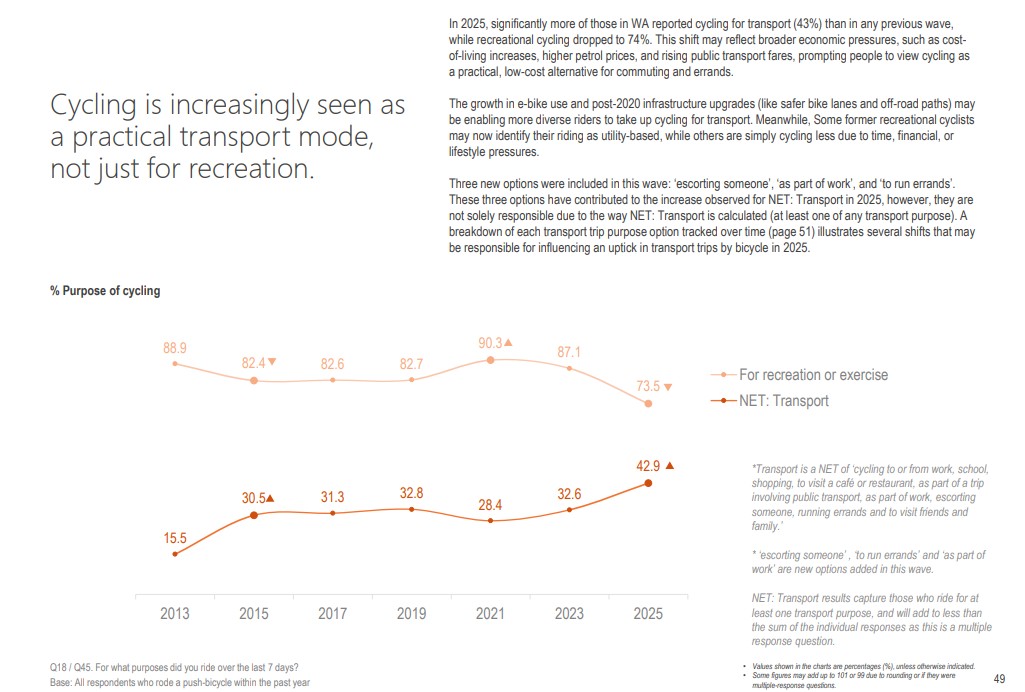
42.9% of WA riders used their bike for transport – the highest proportion on record. For the past year, this works out to 16.13% of Western Australians riding a bike for transport, and 6.58% specifically riding a bike for their commute to work, school or other place of study.
The report’s authors speculate that the shift toward transport riding could be due to cost-of-living pressures, with people using their bikes to save money on public transport fares or fuel. We wondered if the expansion of the PSP network, and a few path disruptions coming to an end could have contributed to an increase in long distance commuter riders.
It could also be that people realise they can save time (one of the barriers to riding, which we discuss below), as well as money, by combining their commute with exercise.
But the trend is clear with those riding for recreation and fitness dropping from about 90% in 2013 to 74% in 2025, while those riding for transport reasons has risen from 15.5% in 2013 to 43% today.
Initiatives like National Ride 2 Work Day help boost transport riding, as do better end-of-trip facilities.
While less people are riding than 12 years ago, if we dig into who is riding we find more men are riding than women annually (45% versus 31%), and more kids are riding than adults.
Programs and initiatives like Women on Wheels, Ride 2 School Day and better in-school bike education are helping to boost participation rates among young people and women.
The metro to regional gap at an annual participation level has narrowed to about 2% since 2019. While the overall participation rates remain lower than 2015 for both cohorts, it is encouraging to see that location is not a huge factor in deciding whether or not people ride.
WestCycle has expanded its regional presence with the appointment of a dedicated Regional Coordinator and engagement with programs like Connecting Communities and Safe Routes to School, both of which aim to increase active transport participation levels.
Ride motivators
Drilling deeper into the motivations for people ride, the most common response was that people would ride more if they had more time (42%).
This wasn’t broken down into gender or age, or the kind of jobs people have, but here are some policy responses that could help give people more time in their day:
- Employers could provide more flexible policies for start and finish times, more working from home options, implement a 4-day work week and offer more and better end-of-trip facilities.
- If people live far from their workplace, riding might take too long to be feasible, even with e-bikes or eRideables. Creating urban environments where more people live close to their workplaces, so their commutes aren’t so long, can encourage more people to ride more often. This goal is indeed detailed in long term planning strategies for Perth and Peel and the State Planning Strategy 2050.
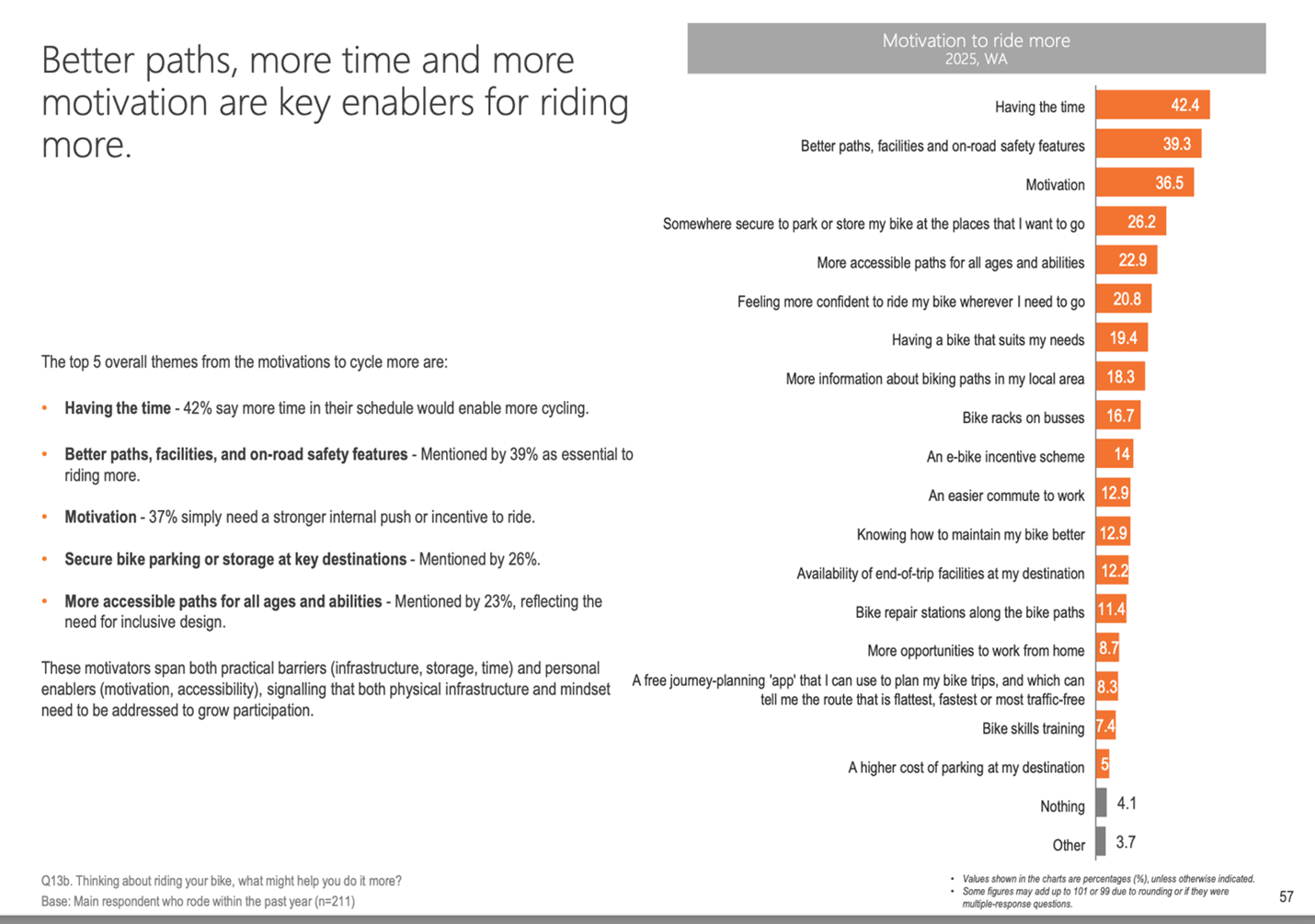
The next most cited riding motivator was better paths, facilities, and on-road safety features (39%). In this area, WestCycle has consistently advocated for faster completion of regional and metro Long Term Cycle Networks and implementing safer speeds and less traffic on local streets. You can check out the State’s regional Cycling Strategies through to 2050 here.
This was followed by an interesting option the survey provided – 37% of respondents said they ‘needed a stronger internal push or incentive to ride’.
Let’s ponder this for a moment – why would people need ‘a stronger internal push’? The most likely reason is a combination of the previous answers (lack of time, limited places to ride) and as far as transport goes, it’s really easy to jump in the car.
When the environment is not conducive to riding (or using active transport) it’s on the individual to make up for it by somehow motivating themselves. Obviously in places where it feels safe and easy to ride bikes, more people find the “internal push” to do it! More than 60% of both male and female riders said they would ride more if there were better local path connections and more off-road shared paths available.
There is a clear need to make more safe places for people to ride, and this goes beyond building bike paths. People need to feel like riding is the easiest and most convenient form of transport, from right outside their door. As the report states, “These findings reinforce the importance of infrastructure and network design in encouraging higher cycling participation across the state.” And of course when governments invest in this kind of infrastructure the positive public health, road congestion – and even economic – outcomes are well-documented.
Bike ownership is declining
Don’t be fooled by the graphs below – they actually say the opposite of what it seems at first glance! Bicycle ownership is declining significantly; nearly half of WA households don’t have a single working bike.
While e-bike ownership is growing modestly (one in 10 households have at least one), this isn’t compensating for the loss of regular bikes.


eRideables
Earlier this year, WestCycle officially started representing eRideable users, so it was great to see these early adopters in the survey data. In WA, 5% of the population (in 3.6% of households) owns at least one eRideable. Perhaps surprisingly to those who think e-scooters skew young, the adoption rate was similar across age groups up until 60, at which point it dropped off.
The next CWANZ survey is due in 2027.